

In order to implement the reform under the Improvement of transparency and access to information of public interest (milestones 229 – 233) of Hungary’s Recovery and Resilience Plan C9.R26, it is necessary to draft reports on semi-annual periods for the second half of 2022 and thereafter each year until the first half of 2026 (altogether eight reports need to be published under the commitment).
Under the European Commission proposal COM (2022) 686, in order to achieve milestone [C9.R26.] for the improvement of transparency and access to information of public interest, Act CI of 2023 on the system of the utilisation of the national data assets and certain services added a new chapter VI/B. to the Privacy Act, which gave a new function and powers to the Authority and in connection to this specified an extended reporting obligation for organs performing public tasks. Pursuant to the provisions of the law, organs performing public tasks, including municipalities and business organisations in public ownership in particular, have to provide data on the preceding year from 2024 by 31 January of each year on
a) the number of meeting and rejecting requests to access data of public interest and data accessible on public interest grounds and the characteristic reasons of rejection,
b) the average number of days needed to meet requests to access data of public interest and data accessible on public interest grounds, and
c) the accurate internet accessibility of the location where data of public interest and data accessible on public interest grounds are published (hereinafter: freedom of information reporting).
Pursuant to Section 30(3) of the Privacy Act, organs performing public tasks shall, as before, keep records on the requests refused and the reasons for refusing them. In addition, pursuant to Section 42 of Government Decree 335/2005 (XII. 29.) on the general requirements of document management by organs discharging public tasks, requests for data of public interest received by such organs will have to be filed so as to be searchable by subject matter. These records constitute the primary basis of the present reporting; however, if warranted, an organ may keep separate records in order to meet a reporting obligation. The reporting constitutes one of the fundamental pillars of discharging its tasks of monitoring compliance with the requirements concerning the transparency and accessibility of data of public interest and data accessible on public interest grounds for NAIH. This is the so-called monitoring procedure. The new, extended freedom of information reporting obligation exists from 1 January 2024.
In addition to the above, based on Section 71/D of the Privacy Act, the Authority shall have to carry out the following tasks as part of freedom of information monitoring:
i. it has to monitor the obligee organs twice a year based on the reporting. Monitoring by the Authority extends to the examination of the public disclosure of data of public interest and data accessible on public interest grounds,
ii. based on notification, the Authority also conducts separate monitoring,
iii. the Authority may request data from the monitored organs for monitoring; the monitored organs are required to comply with such requests within 8 days from receiving the request,
iv. the Authority may make recommendations to the monitored organs with a view to promoting compliance with the requirements for transparency of data of public interest and data accessible on public interest grounds and for their accessibility,
v. the head of the organ affected by the recommendation has to draw up an action plan for the implementation of the necessary measures and transmit this plan to the Authority within 15 days from receipt of the recommendation,
vi. as part of its public report, the Authority has to draw up a report annually on the monitoring.
1.1. Statistical data of freedom of information reporting
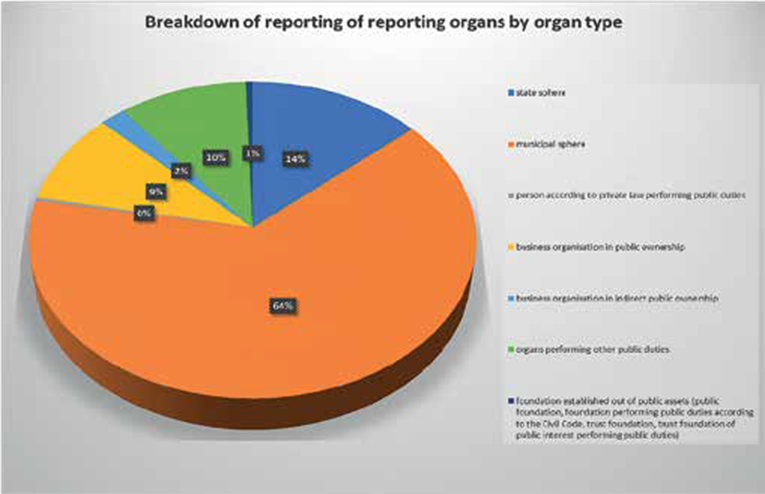
By 31 January 2025, the Authority received reports for 2024 from 5,952 obligee organs covering the following organ types:
- state-owned business organisation, state public authority, state public institution, budgetary organ according to the Act on Public finances, legal entity in the register of the state treasury, public body (public sector);
- local government, body of representatives and its organs, budgetary organs founded and supervised by the local government, minority governments and their organs (municipal sector);
- non-profit business organisation in public ownership, state-owned business organisation performing public tasks specified in legal regulation, state-owned business organisation or municipal business organisation operating with a share in state ownership to be kept in national assets of outstanding significance for the national economy (business organisation in public and state ownership);
- institution maintained by the church, KEKVA (Asset Management Foundation of Public Interest), public foundation, private law organisation discharging public task, legal entity established by law, other (organs discharging other public tasks).
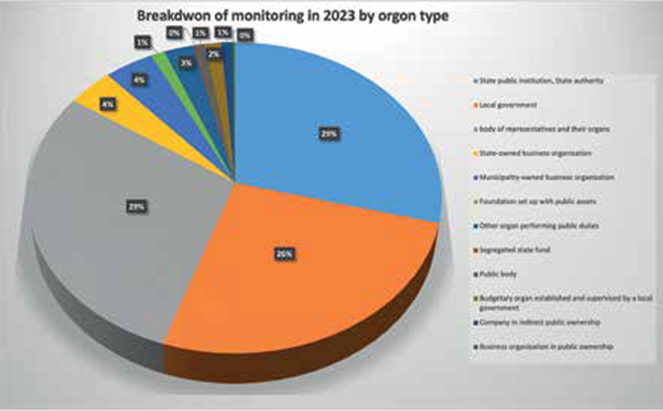
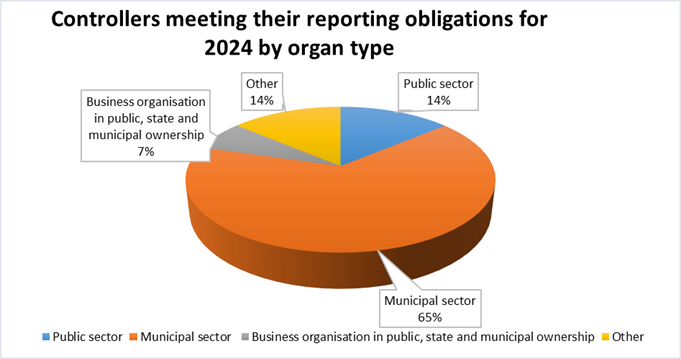
The following figure contains the breakdown of reporting organs by organ type.
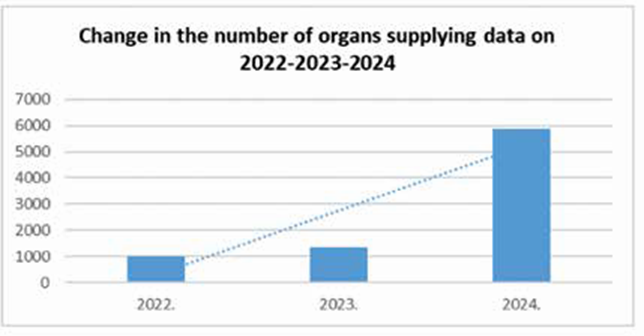
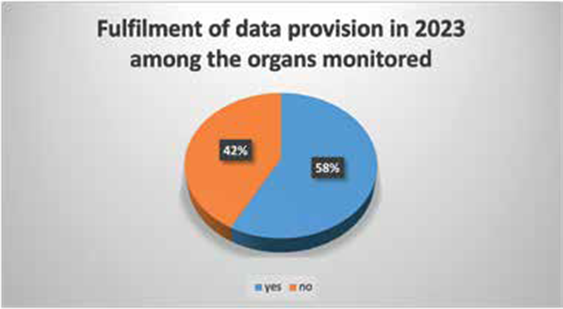
The number of those providing reports continues to be characterised by a rising tendency, as early in 2023, then in 2024 and in January 2025, reporting obligations by the due date specified by law (31 January 2025) were met by 1,350, 5,895 and 5,952 organs performing public tasks (for 2022, 2023 and 2024), respectively.
Local governments and minority governments together with their organs in the municipal sector had the largest cardinality.
With regard to 2022, 584 local governments and their organs and 25 minority governments submitted reports [altogether: 609] – at the time only on the data of rejected data requests. Extended reports on the year 2023 were submitted by 2,612 local governments and their organs, 870 budgetary organs founded and supervised by local governments and 301 minority governments and their organs to the Authority, totalling: 3,783 reporting municipal organs.
With regard to 2024, as many as 2,165 local governments and their organs, 1,220 municipal budgetary organs and 436 minority governments and their organs – altogether: 3,821 organs – met their reporting obligation.
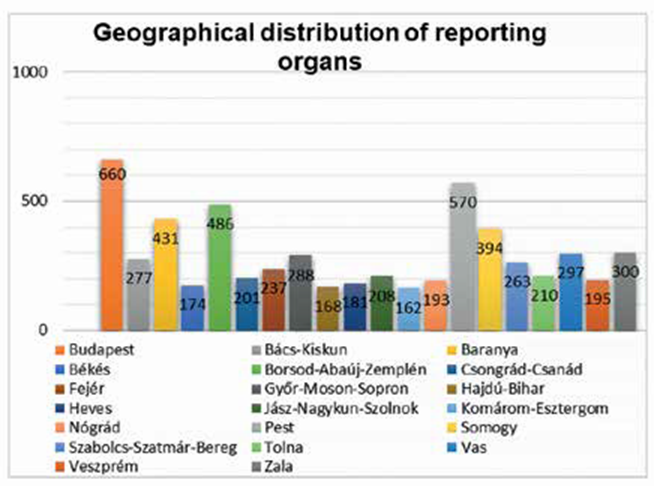
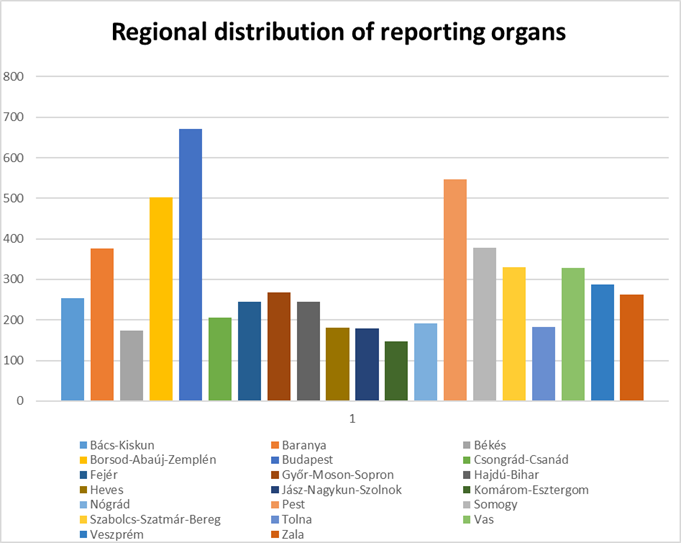
Based on the regional distribution of reporting organs, Budapest submitted the largest number of reports (871), followed by Pest County (547) with Komárom-Esztergom County bringing up the rear (147).
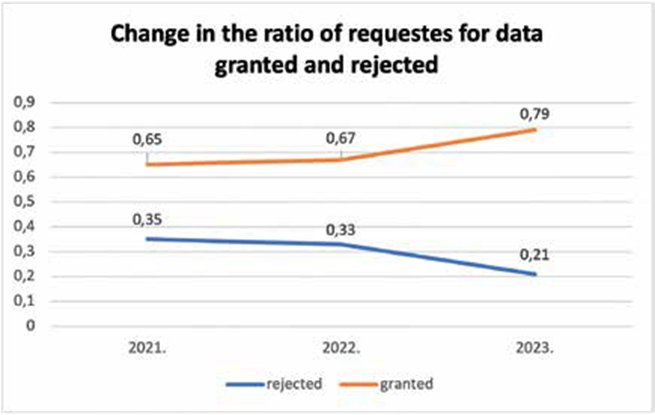
Similarly to the increase in the number of reporting organs, the ratio of requests for data of public interest met and rejected showed a positive change relative to the data of the preceding years:
- in 2023, 3,260 of the 9,739 data requests (33%) with regard to 2022 was closed with the restriction or exclusion of access to data of public interest,
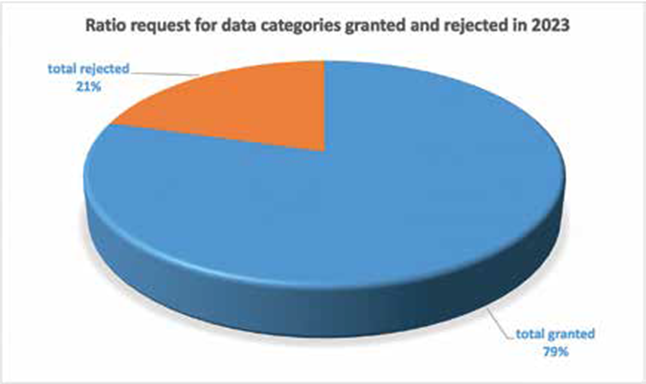
- in 2024, the controller organ performing public tasks declined to grant access to data of public interest in 6,210 cases (21%) of the 14,840 data requests in the reports of 2023, involving 30,238 data types,
- in 2025, organs discharging public tasks had to report on their annual data disclosure practices in a semi-annual breakdown in their reports on 2024. Based on aggregated data, organs discharging public tasks granted access to data in 12,548 datasets out of 16,806 [75%], while access to 4,256 datasets [25%] was refused in the first half of 2024.
According to the data on the second half of 2024, data were released in the case of 9,787 datasets out of requests for 14,004 [77%], but the controller rejected access to 4,215 datasets [23%]. The aggregation of the semi-annual data shows that requests for access to the various datasets were granted in 76% of the cases and rejected on average in 24% of the cases.
A comparison of the data for 2023 and 2024 reveals a slight increase in the ratio of rejections.
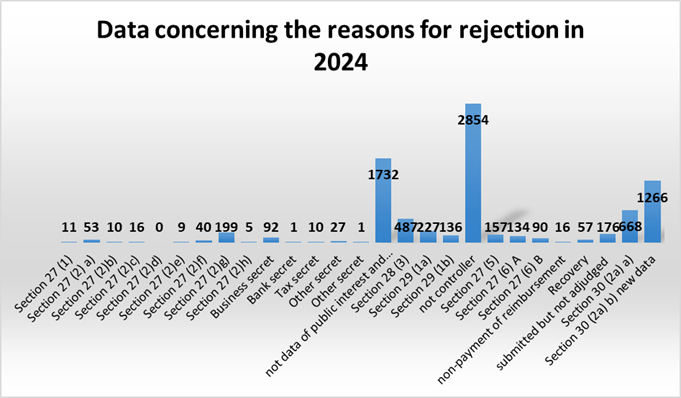
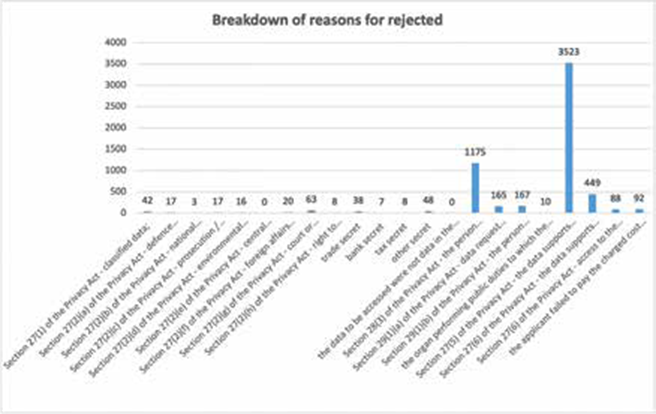
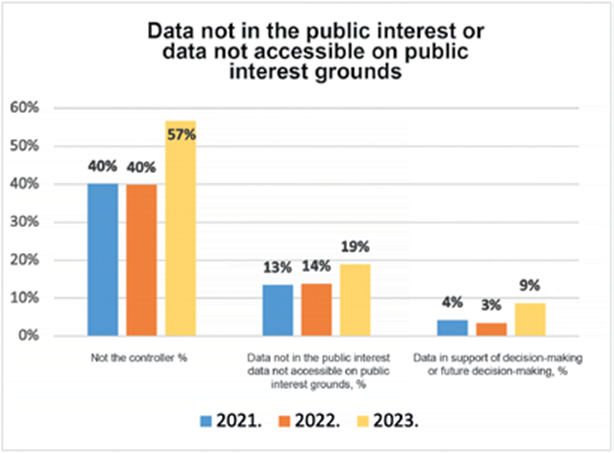
The reasons for rejections applied most frequently in preceding years (2021, 2022, 2023) [data not in the public interest, personal data not accessible on the grounds of public interest, not controller] continued to be at the head of the list in the 2024 reports too.
Essentially, the two new reasons for rejection introduced by Section 30(2a) (a) and (b) of the Privacy Act in force since 1 January 2024 can be interpreted as the same as the reason for rejection “not controller”.
Pursuant to these provisions, the organ performing public duties shall not be obliged to comply with the data request, if meeting the request would necessitate
- procuring or collecting data other than those the organ performing public duties effectively processes, including in particular data that are processed by an organ performing public duties under the direction or supervisions of the former, or
- producing new data relative to the data it processes by comparing data of public interest or data accessible on public interest grounds effectively processed by the organ performing public duties.
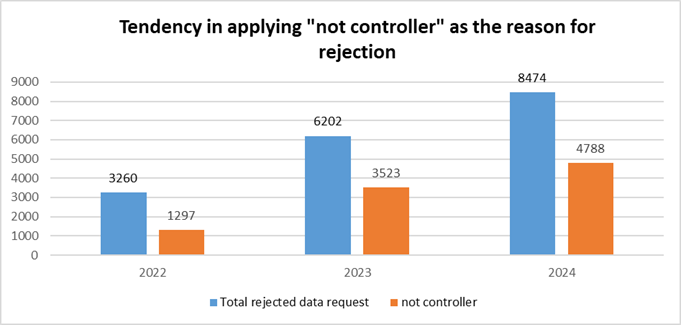
Based on the statistical data, however, this change did not involve an increase in the ratio of rejected data requests with reference to the new reasons for rejection. Whereas in 2023 the reason for rejection that the given organ did not process the data to be accessed made up 57% of all the reasons for rejection, in 2024 references to the two new reasons for rejection and to the “not controller” status together also constituted 57% of the reasons for rejection.
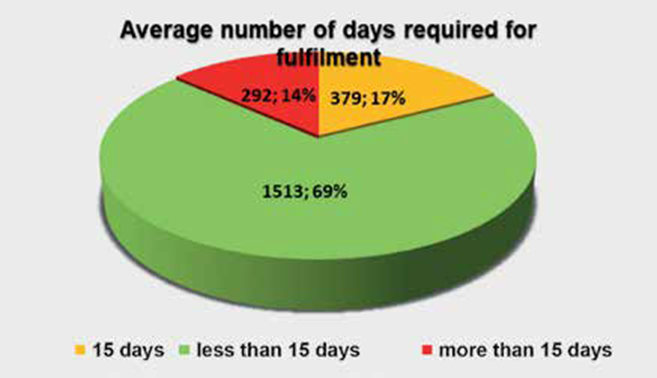
The report extends to determining the average number of days spent on meeting the data requests in a given year. In 2023 and in 2024, 63% and 83% of the reporting organs made so-called “zero” statements, respectively (they did not receive data requests). In 2024, the average number of days spent on meeting data requests was 12.5 in the case of organs performing public tasks, which did receive data requests.
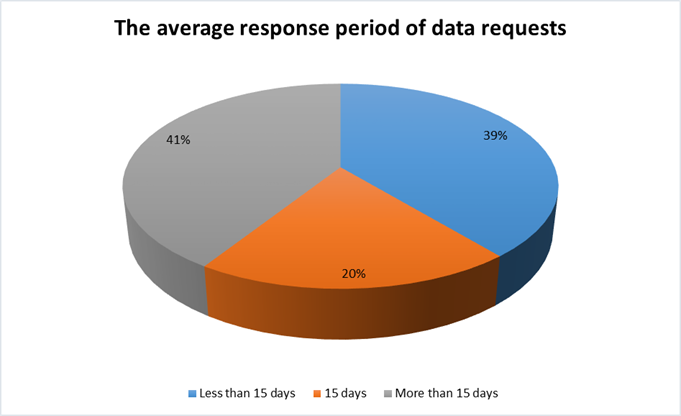
In the case of organs, which received data request (first half of the year: 1,030, second half of the year: 1,035), the average response period was as follows:
- the average response period was 15 days in the case of 20% of the organs [213 organs],
- the average response period was less than 15 days in the case of 39% of the organs [394 organs],
- the average response period was more than 15 days in the case of 41% of the organs [425 organs]
1.2. Monitoring procedures to verify the adequacy of the provision of access to data and to examine the practice of meeting individual data requests
In 2024, the Authority launched monitoring procedures to verify the adequacy of the transparency and accessibility of data of public interest and data accessible on public interest grounds in 53 cases based on Section 71(D)(1) of the Privacy Act. In five cases, this was done based on complaints lodged or freedom of information supervision already in progress and in 48 cases ex officio.
In the case of ex officio procedures, the Authority relied on the data of the reports for 2023 in accordance with Section 71(D)(4) of the Privacy Act; as set forth in the monitoring schedule for 2024, the monitoring affected
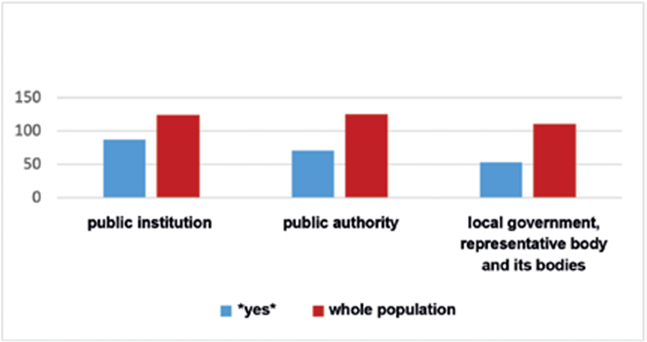
- the reporting organs selected on the basis of their reports, where the selection criteria included, inter alia, the rejection of a large number of data requests or if the period open for meeting the data requests substantially exceeded the 15 days required by law;
- selected organs of the central public administration, and
- organs performing public tasks concerned in supervisory procedures launched on the basis of individual complaint, but which were unsuccessful.
The organs performing public tasks monitored in 2024 were the following: Szerencsejáték Zrt., Dobó István Vármúzeum, Eger MJV Önkormányzata, Újszentiváni Polgármesteri Hivatal, Fejér Vármegyei Katasztrófavédelmi Igazgatóság, HUN-REN Társadalomtudományi Kutatóközpont, Budapest IV. kerület Újpest Önkormányzata, BAZ Vármegyei Központi Kórház, Ópályi Község Önkormányzata, Szabadszállási Roma Nemzetiség Önkormányzat, Tolna Vármegyei Kormányhivatal, Budapest Főváros Kormányhivatal, Pusztadobos Község Önkormányzata, Szomolya Község Önkormányzata, Marcali Város Önkormányzata, Penészlek Község Önkormányzata, MÁV-START Zrt., Győr MJV Önkormányzata, Nógrád Vármegyei Kormányhivatal, Nagynyárád Község Önkormányzata, Szabadszállás Város Önkormányzata, Győr MJV Polgármesteri Hivatala, BTVR Budafok-Tététényért Városfejlesztő Kft., Vilmányi Közös Önkormányzati Hivatal, Pálháza Város Önkormányzat, Hollóháza Község Önkormányzata, Miskolc MJV Polgármesteri Hivatala, Csepeli Önkormányzat, Csepel Polgármesteri Hivatala, KÉZMŰ Közhasznú Nonprofit Kft., ERFO Közhasznú Nonprofit Kft., Dunaújvárosi Vagyonkezelő Zrt., Székesfehérvár Városgondnokság Kft., HungaroControl Zrt., Debrecen MJV Polgármesteri Hivatala, Alacska Község Önkormányzat, Zala Vármegyei Kormányhivatal, Óbuda-Békásmegyer Önkormányzata, Jász-Nagykun-Szolnok Vármegyei Kormányhivatal, Közép-Budai Tankerületi Központ, Hódmezővásárhelyi Tankerületi Központ, Pécsi Tankerületi Központ, Debreceni Tankerületi Központ, Nagykanizsai Tankerületi Központ, NNGYK, Közép-Pesti Tankerületi Központ, Szolnoki Tankerületi Központ, Kecskeméti Tankerületi Központ, Salgótarjáni Tankerületi Központ, Veszprém Város Önkormányzata, Veszprém Város Polgármesteri Hivatala, Litér Község Önkormányzata, Litér Közös Önkormányzati Hivatal.
In the course of the monitoring procedures, the Authority examined not only the requests for data of public interest submitted to and adjudged by the monitored organ in 2023 and the responses given to them; it also reviewed the procedures of the monitored organs granting access to data of public interest. In addition, it also requested the submission of judgments made in public data litigations related to the rejection of access to the data, if there were any.
The majority of the organs discharging public tasks cooperated with the monitoring and responded to the Authority’s questions within short periods, accepted the Authority’s recommendations and produced action plans to remedy the observations made in the recommendations, which in many cases included factors that have been accomplished simultaneously with sending the action plan. At the same time, there was an organ performing public tasks, which showed a total lack of cooperation and not even the involvement of its supervisory organ into the procedure altered their attitude to the monitoring. The monitoring extended to the examination of the lawfulness of the extension of the period open for responding and of the call to clarify the data request, the appropriate application of the restriction on accessing the data referred to in the course of rejecting the data request and the existence of information on the right to legal remedy.
The Authority summarised the deficiencies exposed in the course of the monitoring procedures, its recommendations and the results of the monitoring in the individual reports published in full on its website.[1]
Presumably, the impact of the monitoring procedures will be perceptible in the coming year(s) as the new procedures implemented to eliminate the deficiencies exposed in the data release practices of the individual organs will have to be incorporated into their everyday practice and its effective outcome will be determined on the basis of the examination of the data release practices of the coming year/years and the analysis of the freedom of information reports.
1.3. Monitoring procedures supervising the publication practices of organs performing public tasks
In 2024, the Authority launched 74 monitoring procedures examining publication practices, in 43 cases based on notification and in 31 cases ex officio. In the ex officio procedures, the Authority started off from the results of its previous comprehensive project aimed at the improvement of the efficiency of the freedom of information; hence it supervised the publication practices of ministries, government offices and publicly held business organisations.
Section 37(1) of the Privacy Act requires organs performing public tasks to publish the data specified in the general publication schemes of Annex 1 thereto as specified in Annex 1. Hence, in its monitoring procedures supervising compliance with the publication obligations, the Authority checked not only whether an organ published every single item of the required data, but also whether the publication took place in the structure according to Annex 1 to the Privacy Act, or Annex 1 and 2 of IHM Decree 18/2005. (XII.27.) (hereinafter: IHM Decree) in the required place with the updates at the required frequency and in keeping the necessary retention periods.
The purpose of the general publication schemes specified in Annex 1 to the Privacy Act is that interested parties be able to quickly find the organisational, operational and financial management data of organs performing public tasks, which the legislator defined as the proactive minimum of the freedom of information collected in one place on the website of the organ in a specific way and with specific content. It is a common – but not acceptable – practice to publish the data of the general publication scheme in a fragmented mode in different parts of the organ’s website. Another unacceptable practice is when interested citizens have to find out what is the search word using which they can find the data of the general publication schemes in a database containing data other than the data of the list. Nevertheless, the Authority encountered this solution on several occasions.
In 2024, the Authority examined the publication practices of 9 ministries; it published seven reports on the results of the monitoring procedures, while two procedures were still pending early in February. At the start of the monitoring procedures, not a single ministry had general publication schemes, which would have been drawn up in the structure according to Annex 1 of the Privacy Act, or Annexes 1-2 of the IHM Decree.
Ministries publish data of public interest in a joint document library, which can be searched by ministry organisational and staffing data, activity and operation related data and financial management data. The date of publication can also be set as a filter; search words can also be used. A typical deficiency at the time of launching the monitoring procedure was that the Document Library did not contain a scheme according to Annex 1 of the Privacy Act, one can only search and use filters in it. Filtering for “Organisational and staffing data”, “Activity and operational data” and “Financial Management data” at the same time failed to produce all the data lines according to Annex 1 of the Privacy Act (or folders with corresponding names). The documents accessible in the Document Library do not fully contain the data listed in Annex 1 to the Privacy Act or Annex 1 to the IHM Decree; several ministries hardly published any data of public interest other than the statements of assets and the remuneration for senior political leaders in the Document Library. The Authority called upon the ministries to notify the Authority of the accurate place of publishing the required data by completing the enclosed Annex 1 to the Privacy Act; every ministry complied with this call. After this, the Authority sent a detailed analysis of the missing data and the erroneous publication to the ministries and requested action plans indicating the persons responsible for corrections and a period for completion not longer than 30 days. The Authority summarised its recommendations, the results of the monitoring and the remaining deficiencies in the reports published in full on its website.
All in all, it can be stated that, with the exception of a single ministry, the monitored ministries still failed to publish all the data of public interest required in Annex 1 to the Privacy Act either in the Document Library or in a table format. As a result of the procedure, two ministries uploaded the list according to Annex 1 to the Privacy Act in a table format [NAIH-2405/2025, NAIH-2851/2025]; one of the ministries did so with minor deficiencies. Another ministry uploaded virtually without fail the required data of public interest to the Document Library [NAIH-10195/2024], in this case there was no need to draw up an action plan. Two ministries did publish more data as a result of the procedure, but several datasets were still missing [NAIH-2839/2025, NAIH-2851/2025]. Three ministries made minimal additions or did not upload the missing data at all [NAIH-2836/2025, NAIH-1686/2025, NAIH-2842/2025].
Besides the ministries, the Authority found that several county government offices did not have general publication schemes drawn up in the structure according to Annex 1 to the Privacy Act or the IHM Decree, instead they uploaded data of public interest to the menu “Documents, forms” on the central site of government offices. Because of this, the Authority conducted monitoring procedures against five county government offices in 2024. Four procedures were closed with reports; one procedure is still pending. In the four closed procedures, three government offices published the general publication schemes in the table structure according to Annex 1 of the Privacy Act; one government office already had a scheme – albeit deficient – upon launching the procedure. Two government offices uploaded a larger number of missing data, even though not in full [NAIH-2786/2025, NAIH-3003/2025]; in the case of one government office a major data range continues to be missing [NAIH-1640/2025]. The government office with the deficient scheme made up for the missing data almost in full already at the beginning of the procedure, hence there was no need for an action plan [NAIH-1642/2025].
The Authority monitored the publication practices of a number of municipalities, in most cases based on notification. These procedures showed a varied picture: there were municipalities, which had general publication schemes, but with many data missing; there was one, which had not updated the scheme for two years, and there was another one, which did not even have an operational website, so they did not publish any data of public interest at all. All in all, it can be established that as a result of the monitoring procedures, every municipality uploaded their general publication scheme; however, they failed to publish the required data in full even after the expiry of the action plan due date.
Publication in accordance with legal regulations constitutes a physical and financial burden for small municipalities; they try to use the municipal ASP website, or they purchase similar programs from companies. With regard to the decision-making and the decisions of the body of representatives, the data content of the publication unit is often confused and mixed up by many, and the publication of the data is often deficient. The invitation to the meetings of the body of representatives, the submissions and the minutes of the meetings are published in a variety of ways, in some places at one location containing everything, while elsewhere everything is shown separately. Even if there are data of this type, they are typically showed not under the menu “Data of public interest”, but under other menu points of the website. Information concerning the order of administering municipal authority cases is frequently deficient, or can be found in ways other than incorporated in the scheme. In many cases, the publication of financial management data is also deficient. Notifiers repeatedly object to the absence of justification of the results of tenders. In the case of projects funded with EU support, there is often failure to publish contracts.
Numerous organs find the interpretation of certain datasets problematic, or these datasets are typically absent from the general publication schemes. In the case of grants awarded on the basis of non-individual decisions (no discretion, automatic if the application complies with the legal conditions), the justification should at least indicate the legal regulation and its section containing the conditions of decision-making which enables or requires the grant.
Another general deficiency is that only the public procurement plan is uploaded to the scheme from the data on public procurement; a summary of bid evaluation and contracts is missing. In the case of this dataset, the publication obligation can be met by providing the accurate link to the summaries published in EKR (Electronic Public Procurement System) (it is, however, not sufficient to provide access to the central EKR website).
In many cases, organs performing public tasks publish the public findings of investigations conducted by them and not the findings of investigations run to check their basic activities. In many cases, statistical data are also missing (e.g. OSAP datasheets). With regard to development projects implemented with support from the European Union, the aid contract, as well as the other contracts implementing the investment project must also be uploaded.
Finally, it should be underlined that only a very few organs show the dates of updating the data, in spite of the fact that only with the knowledge of this date can one decide the period reflected in the data and whether the data are valid.
Based on the experiences of the first year of monitoring, it can be established overall that as a result of the procedures, the publication practices of the majority of the monitored organs improved. The Authority published the reports on its website.[2]
[1] https://naih.hu/monitoring-jelentesek-menu-heading/kozerdeku-adat-kiadasi-monitoring
[2] https://naih.hu/monitoring-jelentesek-menu-heading/kozzeteteli-gyakorlatot-erinto-monitorig